March 30: Olympos to Kalkan
Modern statue of St. Nicholas
Previous | March
30 Index | Next | Eclipse
Home 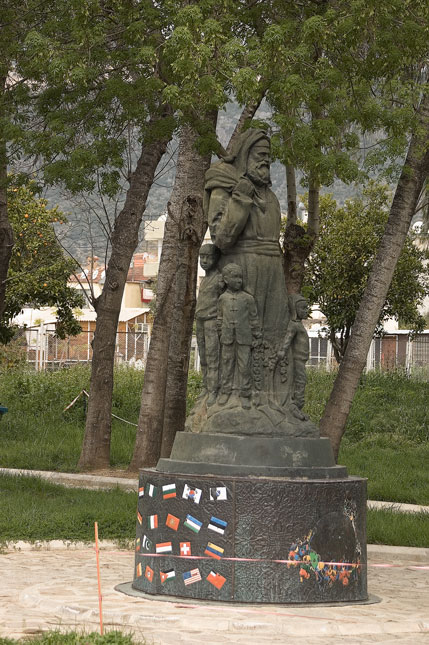
St. Nicholas was born in Patara around A.D. 280 in Asia Minor and became bishop of Myra, now Demre, in Turkey.
The only definite historical evidence of his life is in the records of the First Council of Nicaea in 325, which was responsible for creating the Nicene Creed, a famous statement of doctrine. He was definitely in attendance, although it's not known what role he may have played in the meetings and deliberations.
Nicholas probably suffered in the persecution of Christians under the emperor Diocletian, which lasted until about 311, at which time he would have been around 31-years-old. The new emperor, Constantine, tolerated and then encouraged and finally established Christianity as the state religion. Nicholas died about 343.
It was not long after his death that the legends began and his popularity began to spread.
Saint Nicholas lived his adult life in Myra on Turkey's southwest coast. There he served the people as bishop of the city.
Today visitors to Myra can see the partially restored Church of Saint Nicholas which was built after his death. The remains of "Noel Baba" were placed in a rock sarcophagus within the church. In a nearby park, tourists will find a modern statue of Saint Nicholas complete with beard, bag of toys, and children gathered around him. Unlike the American Santa Claus, St. Nicholas is depicted as a tall thin man, dressed in a hooded robe.
An annual St. Nicholas Festival is held in Myra, for three days around the saint's official Feast Day, Dec. 6. The celebration attracts many tourists who spend their Christmas holidays on the sunny coast of ancient Lycia.