March 30: Olympos to Kalkan
Rock cut tombs at Myra
Previous | March
30 Index | Next | Eclipse
Home 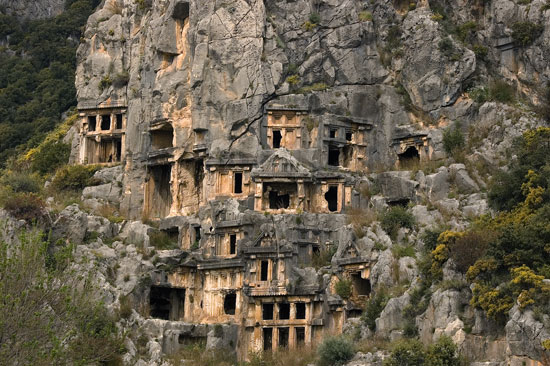
The famous rock-tombs of Myra are in two main groups, one above the theater and the other in a place called the river necropolis on the east side. Although most of the tombs are plain today, Charles Fellows tells that upon his discovery of the city in 1840 he found the tombs colourfully painted red, yellow and blue. The entire cliff face must have once been a bright riot of colour.
To the west of the theatre the steep cliff is pockmarked with a huge number of closely packed rock-cut tombs in an asymmetric pattern, house type rock-cut tombs. A few are temple tombs and one can see steps carved out out the rock that lead to them. Most of the tombs are from the 4th century BC, and many contain funeral scenes in relief, some scenes portraying the daily life of the deceased.
The tombs on the eastern face of the hill resemble those next to the theater. Approached by an uncomfortable rock-path is the monument known as The Painted Tomb, one of the most striking throughout Lycia. It is the ususal house-type tomb with the outstanding feature of a group of eleven life-size figures in relief.