March 30: Olympos to Kalkan
Rock cut tombs of Myra
Previous | March
30 Index | Next | Eclipse
Home
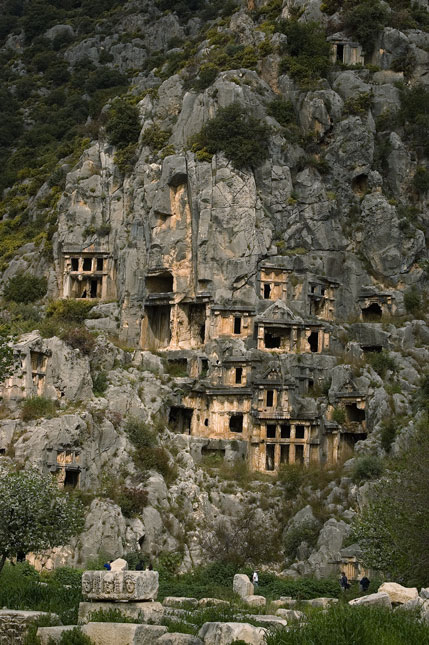
Myra was a leading city of the Lycian Union and surpassed Xanthos in early Byzantine times to become the capital city of Lycia. It is situated about 1.5 km north of today's Demre, on the Kas-Finike road. The large plain of Demre, between Myra and the sea, is today almost covered with greenhouses stuffed full of tomatoes. In ancient times this area was probably farmed extensively.
The date of Myra's foundation is unknown. There is no literary mention of it before the 1st century BC, when it is said to be one of the six leading cities of the Lycian Union (the other five were Xanthos, Tlos, Pinara, Patara and Olympos). It is believed to date back much further however, as an outer defensive wall has been dated to the 5th century BC.
The city is well known for its amphitheatre (the largest in Lycia) and the plethora of rock-cut tombs carved in the cliff above the theatre.
In Roman times the emperor Germanicus and his wife Agrippina paid Myra a visit in 18 AD and were honoured with statues of themselves erected in Myra's harbour. Emperor Hadrian visited Myra in 131 AD and built a huge granary at Andriace composed of seven rooms.
The Eastern Roman emperor Theodosius II made Myra the capital of Byzantine Lycia until the city fell to the caliph Harun ar-Rashid in 808 AD.
St. Paul changed ships at Myra's port on his way to his trial in Rome, in about 60 AD, after he had been arrested in Jerusalem after being charged with inciting to riot. Andriace was a chief port for Egyptian vessels passing through the area; Egypt was the breadbasket of the Roman Empire and the imperial government had a fleet of grain ships that carried grain to Rome and other parts of the Empire. Andriace was a major trans-shipment point for grain from Alexandria - grain came from the plain near Myra and was also possibly brought in by boats, to be shipped onwards from Lycia. It is likely that Paul made the trip to Rome on a grain ship, these were often used to transport passengers as well.
Another popular Christian figure associated with Myra is St. Nicholas. He was one of Myra's early bishops in the 4th century AD, famous for his miracles and known for his kindness.
Because of the terrible plague that swept through Anatolia, Arab raids, flooding and earthquakes, Myra was mostly abandoned by the early 11th century. When the Turks arrived they found a much-shrunken Myra. Today most of Myra is buried underground because its port eventually silted up. However, what remains is very impressive - a large theatre with the backdrop of Myra’s famous rock-cut tombs. The sight of these is quite striking.