March 27: Istanbul to Antalya
Perge Ruins
Previous | March 27 Index | Next | Eclipse
Home 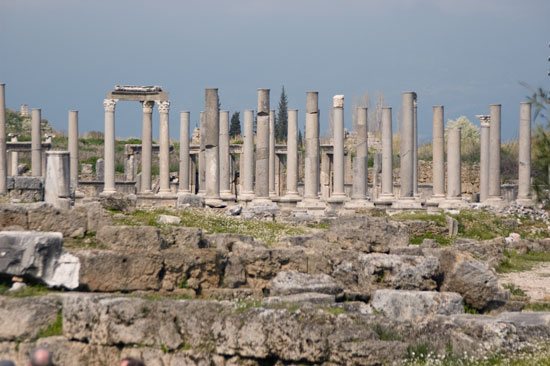
From Aspendos we drove to Perge. Perge was the capital of the then Pamphylia region, which is in the modern day Antalya province.
In the twelfth century BC, there was a large wave of Greek migration from northern Anatolia to the Mediterranean coast. Many settled in the area immediately east of the area of modern-day Antalya, which came to be known as Pamphylia, meaning "land of the tribes". Four great cities eventually developed in Pamphylia: Perge, Sillyon, Aspendos and Side.
Perge itself was founded in around 1000 BC and is nearly 20km inland. It was sited inland as a defensive measure in order to avoid the pirate bands that terrorized this stretch of the Mediterranean. In 546 BC, the Persians defeated the local powers and gained control of the region. Two hundered years later, in 333 BC, the armies of Alexander the Great arrived in Perge during his war of conquest against the Persians. The citizens of Perge sent out guides to lead his army into the city. Later, Alexander was followd by the Seleucids, under whom Perge's most celebrated ancient inhabitant, the mathematician Appollonius (c.262 BC – c.190 BC), lived and worked. Appollonius was a pupil of Archimedes and wrote a series of eight books describing a family of curves known as conic sections, comprising the circle, ellipse, parabola and hyperbola.
Another notable historical figure who twice visited Perge was St. Paul the Apostle and his companion St. Barnabas, as recorded in the biblical book, the Acts of the Apostles (Acts 13:13-14 and 14:25), during their first missionary journey, where they "preached the word" (Acts 14:25) before heading for and sailing from Attalia (modern-day Antalya city), 15 km to the southwest, to Antioch.
Roman rule began in 188 BC, and most of the surviving ruins today date from this period. After the collapse of the Roman Empire, Perge remained inhabited until Selcuk times, before being gradually abandoned.