April 2: Pamukkale to Kusadasi
Agora
Previous | April
2 Index | Next| Eclipse Home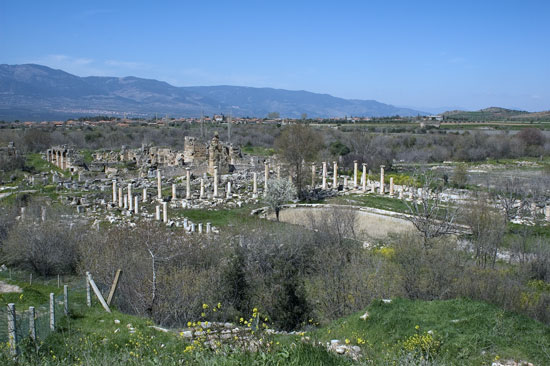
The agora, located between the temple and the acropolis was planned in the 1 St. century B.C. for use as a market and popular meeting place. It is composed of two Ionic porticoes over 200 m long and running from east to west. The southern portico, which is known as the portico of Tiberius, was systematically examined in the course of the older excavations, while the 1937 excavations carried out by the Italian team yielded extremely valuable friezes together with inscriptions written in praise of the Emperor Tiberius.Recent excavations conducted in the northern section, in the western section near the baths of Hadrian and the gate of the agora in the south-east yielded a large number of very fine specimens of the skill of the Aphrodisian sculptors and stone-carvers. Most of the reliefs consist of sacred or individual portraits surrounded by wreaths or garlands, masks and mythological scenes.The monumental gate of the agora is located at the eastern end of the Portico of Tiberius. This ornamental entrance was erected in the middle of the 2nd century but in order to prevent the flooding that followed the 4th century earthquake it was converted into a nymphaeum and connected to a water supply system to be used in controlling the water flow.
This is thought to have been constructed in the 5th century and to have suffered severe damage in the 7th century earthquake. Among the scenes represented on the reliefs in the niches on the Agora gate are to be seen the struggle between the Centaurs and the Lapiths (Centauromachy), between the Gods and the Giants (Gigantomachy) and between the Amazons and the Greeks (Amazonomachy).