April 1: Fethiye to Pamukkale
Kayakoy— abandoned Greek village
Previous | April 1 Index | Next | Eclipse
Home 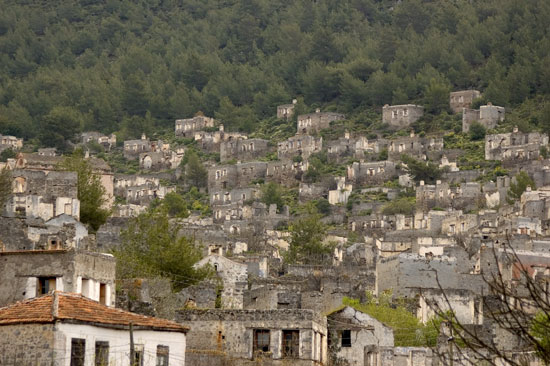
The 1923 Exchange of Populations between Greece and Turkey refers to the first large scale population exchange, or agreed mutual expulsion in the 20th century. It involved some two million persons, most forcibly made refugees and de jure denaturalized from homelands of centuries or millennia, in a treaty promoted and overseen by the international community as part of the Treaty of Lausanne.
Many huge refugee displacements and movements occurred in the upheaval following the dissolution of the Ottoman Empire and its evolution into modern Turkey, especially following the Balkan Wars, World War One, and the Greco Turkish War of 1919-1921, which was part of the Turkish War for Independence. These included smaller exchages of Greeks and Slavs, and Turks and Bulgarians.
Following these models, as part of the Treaty of Lausanne almost all Greeks, about 1.5 million, from Turkish Anatolia and Turkish Thrace were expelled or formally denaturalized, and about 500,000 Turks were expelled from Greece. The Greeks of Istanbul, Gokceada (Imbros in Greek) and Bozcaada (Tenedos in Greek), as well as the Turks and other Muslims of Western (Greek) Thrace were exempted from this transfer.
In Greece this was called the "Asia Minor Catastrophe" as it involved the expulsion of about one third of the Greek population from millennia old homelands.
While the populations which were expelled suffered greatly, both the nation states of Greece and Turkey, as well as the international community, saw the resulting ethnic homogenization of their respective states as positive and stabilizing.
The Turks who had been expelled from Greece went to live near Turkish relatives instead of moving into Kayakoy as they did not want to live in Greek houses.