April 1: Fethiye to Pamukkale
View of Gemiler Island
Previous | April 1 Index | Next | Eclipse
Home 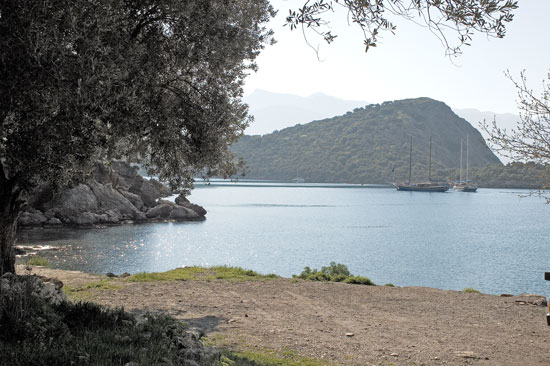
Gemiler bay faces Gemiler Island where the Byzantine ruins of a monastery lie tucked among the olive trees. A Japanese team has carried out archaeological excavations at intervals over the past 10 years and confirmed that this is the once residence of St Nicholas.
The island measures c. 1,000m by 400m, and is separated from the mainland by a narrow channel, which serves as an ideal harbour. In summer seasons it is still frequented by many boats and yachts. The south side of the island is very steep, while the north slope is gentle. Owing to the fact that an earthquake caused the island to sink a little into the water in the year 240 AD, some of the remains lie underwater today. There are also many other remains of houses on the island.
Various kinds of buildings of a medieval city entirely remain on Gemiler Island. Quays are now submerged under the see due to land subsidence. On the north slope hundreds small, secular buildings form a prosperous city. Among many ruins of houses, some remain with very good state of preservation.
There are three churches in the city district. Church I is situated on the shore near the west end of the island. Except for the apse and a baptistery, its walls seem to have been cleared away by waves. Church II stands on the west slope. The semi-dome of the apse is well preserved. Fresco paintings remain around the north door of this church. Church IV is located in the east part of the island. The building is completely destroyed, but there are remains of floor mosaics decorating the atrium of the church. Beyond Church IV is a large graveyard.
The city on the north slope is interrupted by a wall that traverses the hillside. The secluded upper part of the island accomodates only tombs, a huge cistern and Church III. A long, covered corridor connects Church III with Church IV.
When, and how did Gemiler Island flourish and perish? The style of the architecture and the decoration of churches show that they were all built in the late 5th to the early 6th centuries. The development of Gemiler Island depends on its location along the busy route of the Mediterranean Sea. But it does not fully explain the abundance of the buildings on such a small island without flat growing areas.
The relationship between the island and the veneration of St. Nicholas may be another reason of its prosperity. Some late mediaeval documents refer to Gemiler Island as Island of St. Nicholas. Furthermore, fresco inscriptions in Church II suggest that this church was dedicated to him. St. Nicholas, known as Santa Claus today, was originally produced from two Nicholases, Nicholas of Myra of 4th century A.D. and Nicholas of Sion of the 6th century, both born in Lycia.
Early Byzantine Empire witnessed a boom of Christian pilgrimage. The ultimate destination of the pilgrimage was Jerusalem and other sites in Palestine. But the traffic of a great number of pilgrims yielded many local holy sites, which were related to certain specific saints, along the pilgrimage route from Constantinople and other western countries to east Mediterranean region. We suppose that Gemiler Island was exprosively developed as one of these local holy sites.